5 Ways to Stand Out From Your Competition

Pradeep Ayyagari
Jan 20, 2026
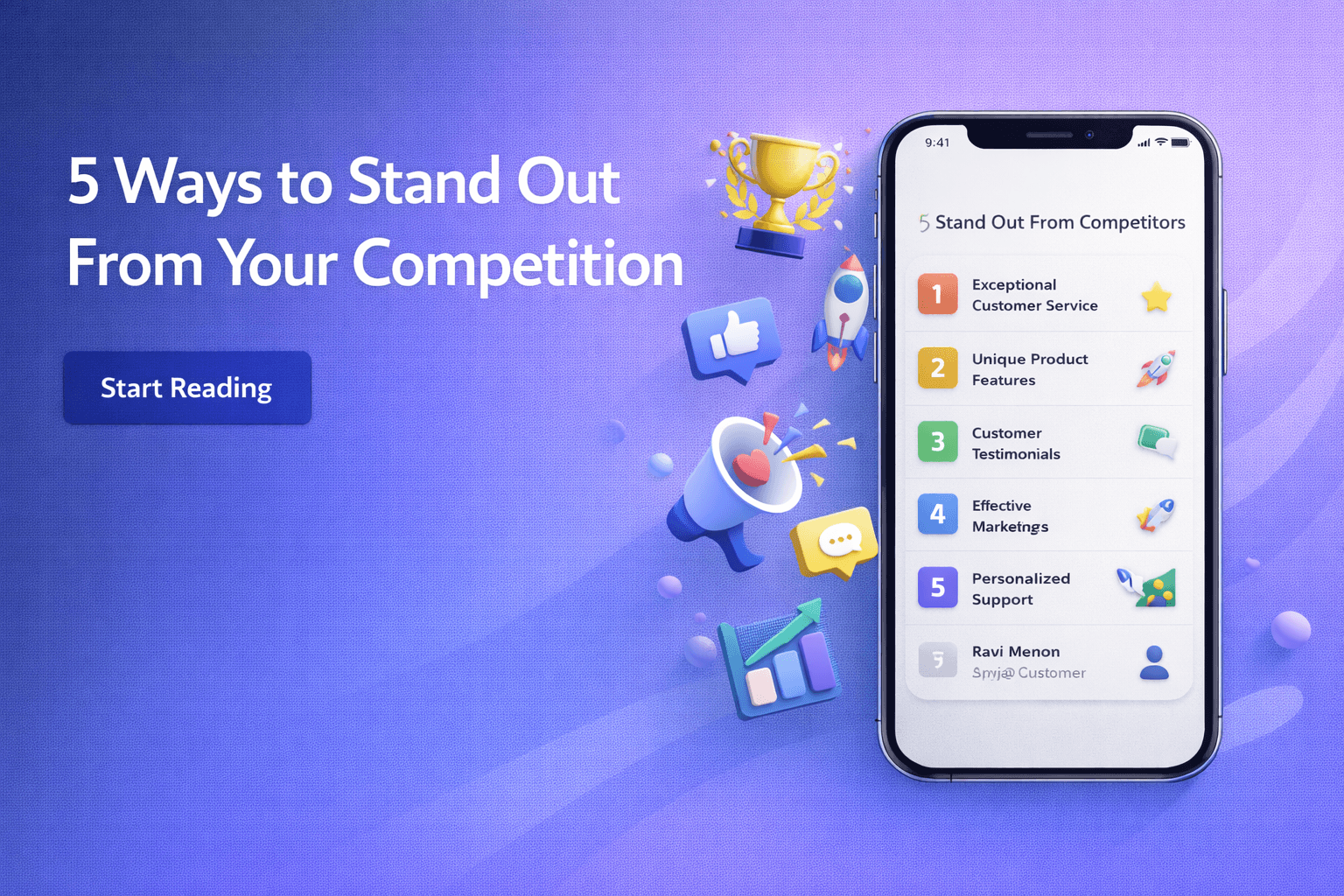
Differentiation is how a business makes itself distinct from competitors offering similar services. 68% of consumers say a brand's unique value influences their buying decision. The good news: standing out doesn't require slashing prices or outspending bigger players.
Key Facts
Customers pay up to 16% more for businesses that deliver better experiences (PwC)
Customer experience drives over two-thirds of loyalty decisions, beating both brand and price (Gartner)
Specialized service providers achieve 5-10x higher returns than generalists
32% of customers leave after just one bad experience, even from brands they love
Loyal customers spend 67% more than first-time buyers
80% of customers prefer businesses that personalize their experience
1. Pick a Specific Problem to Solve
Most service businesses try to serve everyone. A physiotherapist in Pune offers treatment for "all conditions." A CA in Delhi handles "all tax matters." This makes you invisible.
Instead, pick one problem and own it. That physiotherapist could specialize in sports injuries for runners. That CA could focus exclusively on GST compliance for e-commerce sellers.
When you narrow your focus, three things happen: you attract clients who have that exact problem, you can charge more because you're the specialist, and word spreads faster because people remember "the runner's physio" more than "the general physio."
A wedding photographer in Mumbai who only shoots intimate ceremonies (under 50 guests) faces less competition than one who "does all weddings."
2. Fix One Thing Competitors Ignore
Every industry has annoyances that businesses accept as normal. Find yours and fix it.
Salon clients hate waiting past their appointment time. A salon owner in Bangalore who guarantees appointments start within 5 minutes of the scheduled slot instantly stands out.
Tax consultants during filing season are impossible to reach. A consultant in Hyderabad who responds to WhatsApp queries within 2 hours (even during peak season) creates a real difference.
Home bakers often leave customers guessing about delivery times. One who sends real-time updates with photos of the cake being packed gives clients something they can't get elsewhere.
Look at your one-star reviews. Look at competitor complaints on Google. The fix that seems too hard for others is exactly where opportunity lives.
3. Be Memorable in How You Deliver
The service might be identical. The delivery doesn't have to be.
A mehendi artist in Jaipur who includes aftercare instructions on a printed card (with her contact for touch-ups) costs no extra money but creates a lasting impression.
A dentist in Chennai who sends a personalized video message after a procedure stands out from every clinic that sends automated SMS reminders.
A personal trainer in Kolkata who shares a 60-second voice note with each client's weekly progress creates connection that gyms charging ₹50,000/year membership fees can't match.
86% of buyers say they'll pay more for better experiences. You don't need a bigger budget. You need more thoughtfulness in the moments between payment and completion.
4. Say Something Others Won't
Most service businesses sound identical. "Quality service." "Customer satisfaction." "Best rates." These phrases mean nothing.
Take a stand. A tuition teacher in Ahmedabad could say: "I only take 8 students per batch because I've seen what happens in 30-student classes—nobody learns." That's a position. It might turn away parents looking for cheap coaching. It will attract parents willing to pay for actual attention.
A makeup artist could state: "I don't do heavy bridal looks. My style is natural, and if you want to look like yourself on your wedding day, we'll work well together."
Opinions filter out wrong-fit clients and attract right-fit ones faster. Being forgettable is worse than being polarizing.
5. Show Proof That's Hard to Fake
Testimonials are easy to collect. Real proof is harder.
A dietitian who shares before/after results (with client permission) for specific outcomes like "reduced HbA1c from 8.2 to 6.1 in 4 months" beats generic claims about "healthy eating."
An interior designer who publishes project timelines—"Delivered 3-BHK design in 45 days, ₹12 lakh budget, zero cost overrun"—demonstrates something competitors only promise.
A yoga instructor in Gurgaon who posts unedited class recordings shows the actual experience, not curated highlight reels.
Specific results are harder to copy than vague claims. Numbers, timelines, and real outcomes create trust that marketing language cannot.
Common Mistakes When Trying to Differentiate
Competing on price alone. Lower prices attract price-sensitive clients who leave when someone cheaper appears. Differentiation should justify your rates, not destroy them.
Copying competitor differentiators. If your competitor already owns "fastest delivery," claiming the same creates confusion, not distinction. Find unclaimed territory.
Changing positioning too often. Differentiation takes time to register. Switching your specialty every few months means nobody remembers what you're known for.
Making claims you can't sustain. Promising 24/7 availability when you can't deliver it damages trust faster than not promising at all.
Overcomplicating the message. Your difference should fit in one sentence. If it takes a paragraph to explain, it's too complicated to spread.
Quick FAQ
What is differentiation in simple terms?
Differentiation means having a clear reason why customers should choose you over competitors offering similar services.
Can a small business compete with bigger competitors?
Yes. Small businesses can specialize, personalize, and respond faster than large competitors who serve everyone.
Does differentiation mean being the cheapest?
No. Price-based differentiation is weak. Customers paying 16% more for better experiences shows value matters more than cost.
How long does it take to build a differentiated position?
Expect 6-12 months of consistent messaging before your position becomes associated with your business in customers' minds.
What if competitors copy my differentiation?
If your differentiation is based on genuine expertise or operational excellence, copying is hard. Surface-level claims are easily copied; real capabilities are not.
Should I differentiate on service or on who I serve?
Both work. Serving a specific audience (e.g., "tax filing for freelancers") is often easier to communicate than service-level differences.
Is differentiation the same as branding?
Branding includes differentiation but also covers visual identity, tone, and overall perception. Differentiation is specifically what makes you different.
Can I have multiple differentiators?
You can, but one primary differentiator is easier for customers to remember and repeat to others.
What if I can't find anything unique about my business?
Uniqueness can come from how you deliver, who you serve, or what you refuse to do. The "what" might be common; the "how" rarely is.
Do I need to change my services to differentiate?
Not necessarily. Changing delivery, communication, or target audience can differentiate without changing the core service.
Bottom Line
Standing out doesn't require the lowest prices or the biggest marketing budget. It requires clarity about who you serve, what problem you solve, and why you solve it differently. Pick one area - specialization, experience, opinion, or proof—and commit to it. The businesses that win aren't those offering everything to everyone. They're the ones that a specific group of customers cannot imagine going without.